
You are Dishcloth Cotton.You are a very hard worker, most at home when you're at home. You are thrifty and seemingly born to clean. You are considered to be a Plain Jane, but you are too practical to notice.
Take this quiz!
Needle tip to Mary for this quiz.
When I was in high school I wrote a poem called "Life Is a Dishrag." I won't embarrass myself by posting it here (even if I could find it), but I was very proud of how well the metaphor worked when I wrote something along the lines of "grab hold of the dishrag of life and squeeze . . . squeeze . . . squeeze."
Apparently I was wrong. Life isn't a dishrag, *I* am. And while I don't find the above description very flattering, I have a horrible feeling it's pretty apt. Except for the thrifty and born to clean part--where did that come from?
The last, horrible irony? I actually have that yarn.
I've since corrected it, but if you copied the Buttermilk Cocoa Cake from the post below, you might want to change the oven temperature from the 250 deg. F. I mistakenly typed to the correct 350 deg. F.
Then go make it. It's delicious.
 I'm very picky about my salad dressing. It can't be too acidic, too sour, too sharp, or too sweet. It has to be the perfect blend of all of those components for me to fully embrace it. And while I've always secretly wished I was one of those people who could just ask for "oil and vinegar" on the side, I want more flavor than that.
I was raised on store bought, which definitely skewed my idea of what salad dressing should be. For me, the salad was merely the vehicle by which I would consume mass quanitities of dressing. I would pour on so much that there would be a huge puddle at the bottom of the bowl when the salad was gone, which I would happily slurp up. If a salad was naked I wanted no part of it.
But over the past few years, as I've become a more conscious eater and have worked to eat as few processed foods as possible, I've discovered that my tastes have been changing. I love the taste of fresh fruit and vegetables all by themselves. When you rid your palate of all of the additives that get thrown into processed foods, you can start to taste more of the natural properties of fruits and vegetables.
I remember a recent conversation I had with my nephew. We were talking about fruit. He doesn't eat it very much--doesn't care for the taste. He told me it never tastes as sweet as fruit-flavored candy. I knew what he meant. When you eat foods that have a lot of sugar in them, it makes it harder to taste sugar that occurs naturally. When I first decided to try to eat more whole foods, I didn't particularly enjoy them. But I stuck with it and, after a short period of time, I bit into an apple that was so sweet and tasty it almost made me cry. I could taste the difference between kinds of apples. Oranges were a burst of flavor. Vegetables had a subtle sweetness that I could taste for the first time.
Which brings me back to salads. Over the past couple of years, I've come to love salads for the basic ingredients--the lettuce, spinach, carrots, cucumbers, tomatoes, and whatever else I happen to throw into one. I still don't like to eat one naked, but what I'm looking for in a dressing has changed since the days when I would go through a large bottle in three or four salads.
Now I want my dressing to enhance the salad, not drown it. I've played with making my own in the past, but I could never achieve the right balance of oil, sour, sweet and sharp. But this recipe I found in The Best Vegetarian Recipes by Martha Rose Shulman is just what I was looking for. It has a balanced base, to which I have enjoyed experimenting with additional flavors.
This is her basic vinaigrette recipe. The book has a whole section on variations. When I make it, I add the rest of the olive oil, rather than adding it with each use. She also recommends that you remove the garlic if you're not going to use the dressing right away, as it can get bitter. Being the garlic lover that I am, I don't bother with that. So far no problem.
I added some tarragon to this batch. It's good, but I didn't add enough. I also used Trader Joe's Orange Muscat Champagne vinegar instead of balsamic, because that's what I had in my fridge.
I use 1/3 cup each of the olive and canola oils, then add another third of a cup of olive oil at the end. At some point I plan to try it with the yogurt.
This dressing lasts me far beyond three or four salads.
Home Cookin 4.9 Chapter: Sauces
Vinaigrette for the Week
1 Tbsp. balsamic vinegar
5 Tbsp. sherry or red wine vinegar
salt to taste
1 Tbsp. Dijon mustard
1/3 c. olive oil
1/3 c. canola oil (or olive oil)
2 garlic cloves, minced
1/3 c. yogurt, or additional olive oil
Whisk together vinegars, salt and mustard. Whisk in 1/3 c. each olive and canola oils. Transfer to a container and refrigerate.
To serve, add 1 part olive oil to 3 parts dressing.
Makes 1 cup
from The Best Vegetarian Recipes, by Martha Rose Shulman (Morrow, 2001)
Today is my friend Melinda's birthday (Happy Birthday, Melinda!). I knew I was going to see her Saturday so I decided to bake a cake to take to her. I had some buttermilk left over from the gingerbread I made last week and I had just finished the chapter on chocolate cakes in Laurie Colwin's More Home Cooking, which just happened to have a recipe for buttermilk cocoa cake. It sounded so good I thought it would be the perfect cake to make.
 This is how it came out. The batter was thick and rich and the cake cooked up light, but solid. Melinda was kind enough to share it with us at the shop yesterday after I gave it to her, and if I do say so myself, it was rather good. Light, not too sweet, loaded with that deep dusty cocoa flavor. It's supposed to be one of those cakes that gets better every day. I definitely plan to test that out soon. I'll get back to you.
Melinda's friend Beth had invited some friends over for a dinner to celebrate both Melinda's birthday and that of another friend, who's birthday was a couple of weeks ago. So after spending the day at the shop we hopped on the bus and rode over to Beth's house. She has a beautiful place full of wonderful knick-knacks, art (some by Beth, some by others), all things dog including Romeo, the sweet, loveable, most beautiful dachshund I've ever seen.
Beth is a wonderful cook. After enjoying a beautiful arrangement of hors d'oeuvres which included a delicious cheese, figs, dates, caper berries (more on those later, I think), olives and crackers, we sat down to a wonderful chicken tagine with couscous. Over the course of the meal the conversation got so engrossing and lively that the salad course was completely forgotten! But that was ok, because it left more room for dessert.
Which leads to cake number two:
 This is all that's left of the more substantial amount I brought home with me last night. Even though I knew I wanted to take a picture of it, I couldn't stop nibbling away at it. It is one of the most delicious cakes I've had in a long time. Beth told us it's made mostly with ground almonds and very little flour, and some port that is reduced to three tablespoons. She served it with whipped cream and mangoes and it was the perfect combination of cream, mango, and rich creamy chocolate. There was the most lovely little bite of a tang that hits just before you swallow, I suppose from the port.
Both recipes came from Julee Rosso's Great Good Food. I think I'm going to have to get my hands on that book. Beth said she stayed at their bed and breakfast and it was heavenly. If the two dishes I had last night are any indication, I can believe it.
As for the Gingerbread, I was able to ration it out over five days (really!). It got darker, richer, moister, and spicier each and every day.
Here's the recipe for the buttermilk cocoa cake:
Home Cookin 4.9 Chapter: Cakes and Pies
Karen Edward's Version of Buttermilk Cocoa Cake
1-3/4 cup flour
3/4 cup unsweetened cocoa powder
1 cup sugar
1 teaspoon baking soda
1/4 teaspoon salt
1 cup buttermilk
1/2 cup vegetable oil or melted butter
2 teaspoons vanilla
Preheat oven to 350 deg. F. and butter and flour a 9x2" round cake pan.*
Mix together flour, cocoa, sugar, baking soda and salt
To these ingredients add buttermilk, vegetable oil or butter, and vanilla. Mix. Turn batter into the pan, bake the cake in the middle of the oven for 30 minutes, or until a tester comes out clean, and let it cool for 5 minutes before turning it out of the pan.
*I only had a 9x1-1/2" cake pan and it came out fine.
from More Home Cooking: A Writer Returns to the Kitchen, by Laurie Colwin (Harper Perennial, 2000)
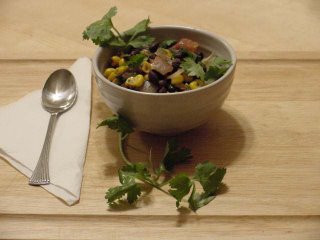 I cooked up some black beans the other day. I froze half for later and put the rest in the refrigerator to think about what I wanted to do with them. I could have made Ten-Minute Black Beans with Tomatoes and Cilantro, a recipe I got from my sister which is fast, easy and delicious and which I will someday share with you. Or I could have made Southwestern Black Bean Soup, or Caribbean Vegetable Stew, or some other more complicated recipe. But I wanted something I could throw together fast and I don't want to get tired of the Ten-Minute Black Beans and I've been making them a lot lately.
I had some Trader Joe's roasted corn in the freezer. I love black beans and corn together. And we had been talking about lime-cilantro rice at the knit shop the other day, which reminded me I had made up a lime-cilantro corn dish a couple of weeks ago. It seems like I was starting to get the shape of what I was looking for.
So I made up this lovely dish. I'm calling it Black Beans and Corn with Lime and Cilantro. Not very original, I know, but it does the job, descriptively speaking.
Home Cookin 4.9 Chapter: Beans and Vegetables
Black Beans and Corn with Lime and Cilantro
2 tablespoon olive oil
1 medium onion, chopped
6 cloves garlic, chopped fine
salt to taste
1 14.5-ounce. can diced tomatoes, with juice
3 cups cooked black beans, or 2 14.5-ounce cans, rinsed and drained
1 pound bag frozen sweet corn*
1/4-1/2 teaspoon cayenne pepper
3 tablespoons lime juice
1/4 cup chopped cilantro
*Especially good with Trader Joe's Roasted Corn
Heat oil in large skillet over medium heat. Add onion and saute for approximately two minutes. Add garlic and salt. Saute for approximately five minutes more.
Add tomatoes and cayenne and simmer for five minutes. Add black beans and corn and cook approximately ten minutes, until heated through.
Take off heat, stir in lime juice and cilantro. Serve immediately.
Makes 6 servings.
Even though I already had most of the ingredients on hand, I just couldn't get myself up and out to the grocery store to buy the few things I needed for my feast of St. Joseph minestrone yesterday. It was a lazy day at home--I mostly worked on some finishing for the knit shop and took some White Bean Stew out of the freezer.
So today I thought I should make something Italian in honor of St. Joseph, although since I'm not Catholic I doubt my lack of activity yesterday meant anything to anyone but me. But what to make? I still hadn't made it to the grocery store so I had to rely on what I have on hand.
Which is: garlic, canned tomatoes, and pasta. And a flash of inspiration: some not-so-fresh spinach that should have been eaten days ago. I was going to saute it in olive oil and garlic and then make some pasta sauce when I had my magical thought. Why don't I just add the spinach to the pasta sauce?
Et voila (pardon my French) -- Farfalle Florentine:
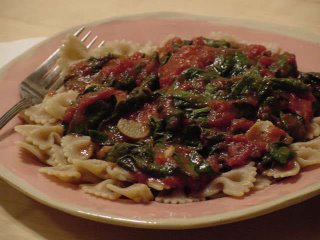 This sauce is a recipe I've been making for the past couple of years, and I've pretty much perfected it. The final touches came from Mario Batali's Molto Italiano: 327 Simple Italian Recipes to Cook at Home. His basic tomato sauce recipe called for thyme and basil.
What? No oregano? I was skeptical to say the least. But I tried it, and, with a nod to Mikey's sibs, I liked it. A lot. I still use oregano, but not for this recipe. The thyme and basil give the tomato just the right amount of sweetness; sometimes oregano can be overpowering.
I also don't put onions in this sauce. I'm not sure why that is, but after years of putting onions and garlic in *everything* I make, I've decided there are some things that are better without both (but never either). Maybe it's because I can taste more subtle flavors since I quit smoking, but I like to mix things up more now than I used to.
It's a pretty standard technique. I use whatever vegetables I have on hand for this. Tonight was actually the first time I used spinach. I often use Trader Joe's frozen artichoke hearts, which I add while the pasta is cooking, or zucchini, which I saute with the garlic. Sometimes I'll cook an eggplant in the microwave and scoop it into the sauce at the end. This is especially good with polenta.
Farfalle Florentine
2 Tbsp. olive oil
6-8 cloves garlic, sliced thin
1 28-oz. can tomatoes, any style (although lately I'm liking with basil added)
1 tsp. thyme
1/2 tsp. basil
salt and pepper to taste
1 10-oz. bag fresh spinach, rinsed and drained
10-oz. bag whole wheat farfalle
Fill pasta pot with water and turn heat on high.
Heat oil in large skillet. Add garlic and saute until just translucent or golden brown, depending on your mood. Add salt and pepper toward the end. Add tomatoes, thyme, and basil. Bring to low simmer and cook for twenty minutes or so, until sauce thickens.
When water for pasta is boiling and sauce has thickened, add pasta to pot and cook per package directions. Add spinach to sauce, stirring until spinach has reduced into the sauce.
By the time the pasta is cooked, the spinach should also have cooked into the sauce. Serve sauce over drained pasta.
Makes 4 servings.
ERIN GO BRAGH!
 As it turns out, corned beef and cabbage is about as Irish as Spaghetti and Meatballs is Italian. At best it can be considered a recent Irish-American tradition for St. Patrick's Day. Most cattle was used for milk, not for eating. Apparently, they were fond of pig. You can get the full story here.
Authentic or not, it tastes good. This was the third of the slow cooker test recipes. I think by the third time I had a better sense of how the slow cooker works. I cut down on the cooking time a little since my cooker seems to run hot. The recipe said to add water just to cover the meat. It was a lot of water, which was why I had a bad feeling about it. But it turned out ok. You cook the beef and vegetables first, then you cook the cabbage after you take the other stuff out. Ironically, the cabbage was a little undercooked, but that was easily fixed in the microwave. And better undercooked than mush, as I always say.
I had originally planned to make Irish stew, but I couldn't find any lamb so I changed plans mid-shopping. The only real difference is that I had already put the boiler onions into my basket and forgot to switch them out for a regular yellow onion, so I just used the boilers. I don't think it made a difference, except that boiler onions get really sweet when you cook them. They tasted fine, but I think regular onion might blend in a bit better.
I also made a point of getting the whole cloves the recipe called for rather than using ground. I'm glad I did that because I think that's one of the things that made the Lucky Chili taste funny. I also substituted vegetable broth for the beer.
And I just realized I used two tablespoons of brown sugar instead of the two teaspoons. That was simply a mistake--I assumed it was two tablespoons. Who firmly packs two teaspoons of brown sugar?
This was ridiculously easy to make. It's probably not the healthiest way to eat beef, but every once in a while you just need to go for it.
Home Cookin 4.9 Chapter: Slow Cooker
Corned Beef and Cabbage
6 med.-size red potatoes, quartered
4 med.-size carrots, cut into 2" chunks on the diagonal
1 med.-size yellow onion, cut into 6 wedges
one 3-4 pound corned beef brisket with seasoning packet, rinsed
3 cloves
1/2 teaspoon black peppercorns
2 teaspoons firmly packed dark brown sugar
1 12-ounce. can beer, strong or mild flavored
1 medium-size head white cabbage, cut into 8 wedges, each secured with kitchen twine
1/2 Cup Dijon mustard for serving
Put potatoes, carrots and onion in slow cooker. Lay corned beef on top of the vegetables and sprinkle with the seasonings from packet, the cloves, peppercorns, and brown sugar. If the meat is too big to lie flat in your cooker, cut it in half and stack the pieces one atop the other. Add the beer and enough water to just cover the brisket. Cover and cook on low for 9-11 hours.
Remove the corned beef and place in a serving casserole. Arrange the vegetables around the beef; cover with aluminum foil to keep warm. Put the cabbage in the cooker with the cooking liquid and turn the setting to high. Cover and cook until crisp-tender, 20-30 minutes.
Serve the beef, sliced across the grain, with the mustard, vegetables, and cabbage. Pass the juice from the crock in a bowl.
Serves 8
from Not Your Mother's slow Cooker Cookbook, by Beth Hensperger (Harvard Common Press, 2005)
I have a confession to make. I've never made gingerbread. Nope, not once. I've wanted to. I've meant to. But I never found a recipe that appealed to me enough that I just HAD to make it.
And then I started re-reading Laurie Colwin's Home Cooking, a series of chatty essays on food and cooking that I'm going to review on the new cookbook blog that's starting up in a couple of days.
I loved this book as much this time around as I did the first time. It's funny and charming, but it has a bite. Kind of like gingerbread. And when I got to the chapter on gingerbread, I was suddenly (and finally) inspired to make some.
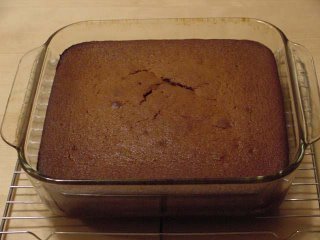 Here it is fresh out of the oven. My apartment smelled so warm and spicy while I was making it, and then as it was cooling. I don't know why I've never made it before. It's delicious! In addition to the ginger, Laurie's recipe calls for cinnamon, cloves, and allspice. She also mentions a molasses called Steen's Pure Ribbon Cane Syrup. I'd love to get my hands on some of that.
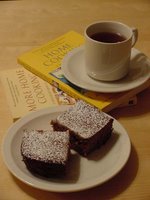 This is the picture I'm going to use for my review. I'm trying to get more creative with the camera. It's interesting, because I start to think of things like "I should put a little sprig of mint on the plate with the gingerbread." Which is a good idea, if I happened to have any fresh mint lying around. But I don't, and right now I can't afford to be buying food just for the visual appeal. But wouldn't that be pretty?
The tea is a black currant tea I bought a couple of months ago at Argo when I was there with Lynda. It's dark and fruity with just a teensy hint of sweetness. It went well with the gingerbread.
I'd offer you some, but by the time you read this post it will probably be all gone.
OK, here's my theory for 24: It's the last season so they're just going to kill everyone off and end the world. The only person left alive will be President Logan, standing on top of the pile of rubble that was L.A., shaking his head and crying "What was I supposed to do?"
Just so you don't think I've stopped knitting, I finished the socks I started in Austin.
 I'm quite happy with them. They fit well. Now I get to decide which sock yarn to use for the next pair.
Corned beef is in the slow cooker. I have a baaaaaaaaaaaaaaaad feeling about this . . .


